Value streams
The Business page introduced Cadence's two value streams — the end-to-end journeys, told from the customer's side, that the whole enterprise exists to deliver. This page puts them to work as synthesis artefacts: first by cross-mapping the streams against the capabilities that serve each stage, and then by tracing a single stream all the way down the stack in the layered view — the one diagram that shows motivation, strategy, business, application, and technology as parts of one model.
This is where the section pays off. Every layer built so far becomes one picture, and one line of sight, from a boardroom goal to the cloud it runs on.
Two synthesis views, one point
- The value-stream ↔ capability cross-map — both streams, drawn against the capabilities that serve each stage, so you can see which abilities the two channels share and where an omnichannel programme's leverage really is.
- The layered view — a curated cross-layer slice of the model tracing the omnichannel thread top to bottom, with authentic ArchiMate notation on every connector.
In the TOGAF ADM these are the artefacts that make the ADM iterate: the cross-map feeds capability-based planning (Phase A), and the layered view is the traceability that lets Phases B–D stay one coherent architecture rather than three disconnected diagrams.
End-to-end value streams — a recap
A value stream is an end-to-end sequence of stages delivering a result of value to a stakeholder, told from their perspective and living at strategy altitude (a Value Stream is a Strategy-layer element, like a capability). Cadence runs two, one per channel:
- Sell a bike in-store — Welcome → Advise & Fit → Purchase → Prepare & Handover. The walk-in journey Cadence is already strong at.
- Fulfil an online order — Browse → Order → Pay → Pick → Ship / Collect. The journey the transformation is investing in.
The single most useful property of a value stream is the stage ↔ capability link: each stage is served by the capability that makes it possible. That link is what lets you point at a stumbling stage and name the exact ability to fix — and it is the hinge the rest of this page turns on.
The value-stream ↔ capability cross-map
Lay the two streams out together, with the serving capabilities in a band between them, and you get a cross-map: a single picture of which capabilities carry which stages, across both channels at once.
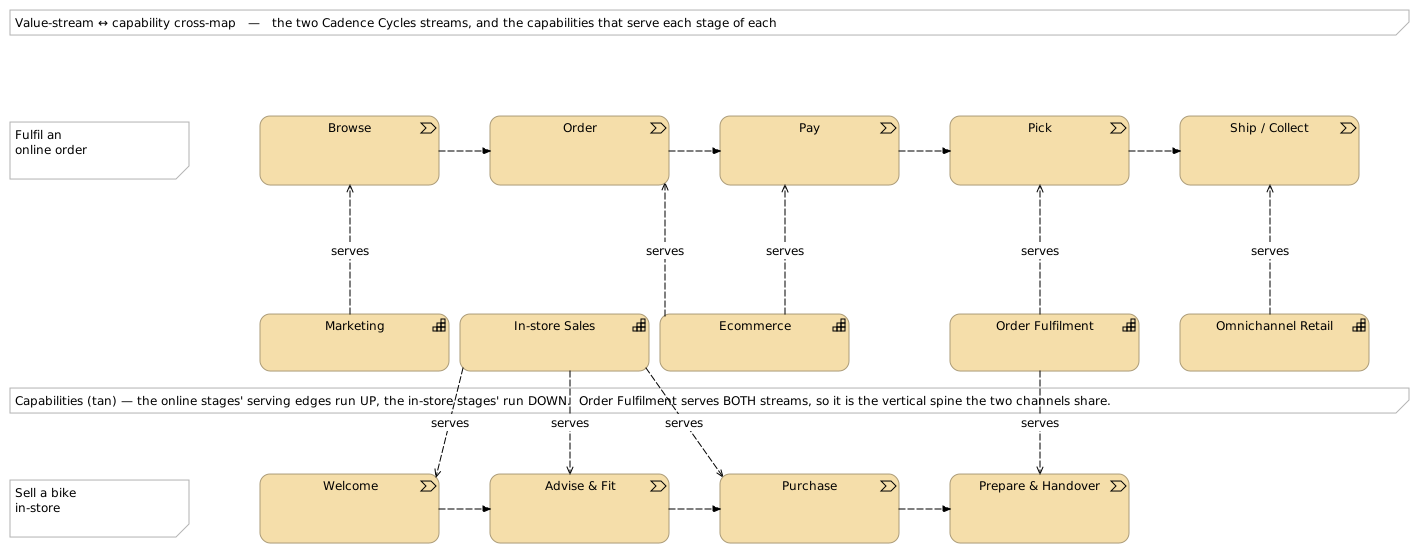
The value-stream ↔ capability cross-map — an authentic Archi export. Chevrons are Value Stream stages linked by flow; the tan boxes are the Strategy-layer capabilities, each connected to the stages it serves. The online stream's serving edges run up; the in-store stream's run down — so a capability's reach across the two channels is visible in its fan of arrows.
Read it for reach. In-store Sales is a tall single column: it carries almost the entire in-store stream by itself — one strong, mature capability doing one channel's work, which is exactly why the heat map leaves it cool. The online stream tells the opposite story: it is spread across four capabilities — Marketing, Ecommerce, Order Fulfilment, Omnichannel Retail — no one of which owns it, which is precisely why omnichannel is hard and why three of those four run hot.
The keystone is Order Fulfilment: it is the one capability that serves both streams — the Pick stage online and the Prepare & Handover stage in-store — so it sits as the vertical spine the two channels share. That shared spine is the whole omnichannel thesis in one element: the ability that lets a bike ordered online be picked in the same operation that readies a bike bought in the shop is the ability that makes "buy anywhere, fulfil anywhere" real. Invest in Order Fulfilment and both channels improve — which is what earns it a hot tile and an early slot on the roadmap.
Why the cross-map beats two separate value-stream diagrams
Drawing the streams apart (as the Business page does) teaches each journey. Drawing them together, against shared capabilities, teaches the portfolio: it surfaces the capability that spans channels, the stages that lean on a hot ability, and the honest fact that the online stream has no single owner. The cross-map is the artefact that turns "we're doing omnichannel" into "here are the four capabilities that decide whether we succeed, and the one that helps both channels at once."
The layered view — the whole model in one picture
Everything so far has been a slice of one layer, or a link between two. The layered view is the synthesis: a single, curated thread that starts at a boardroom goal and descends through strategy, business, application, and technology to the cloud node it ultimately runs on — every connector a real, authentic ArchiMate relationship.
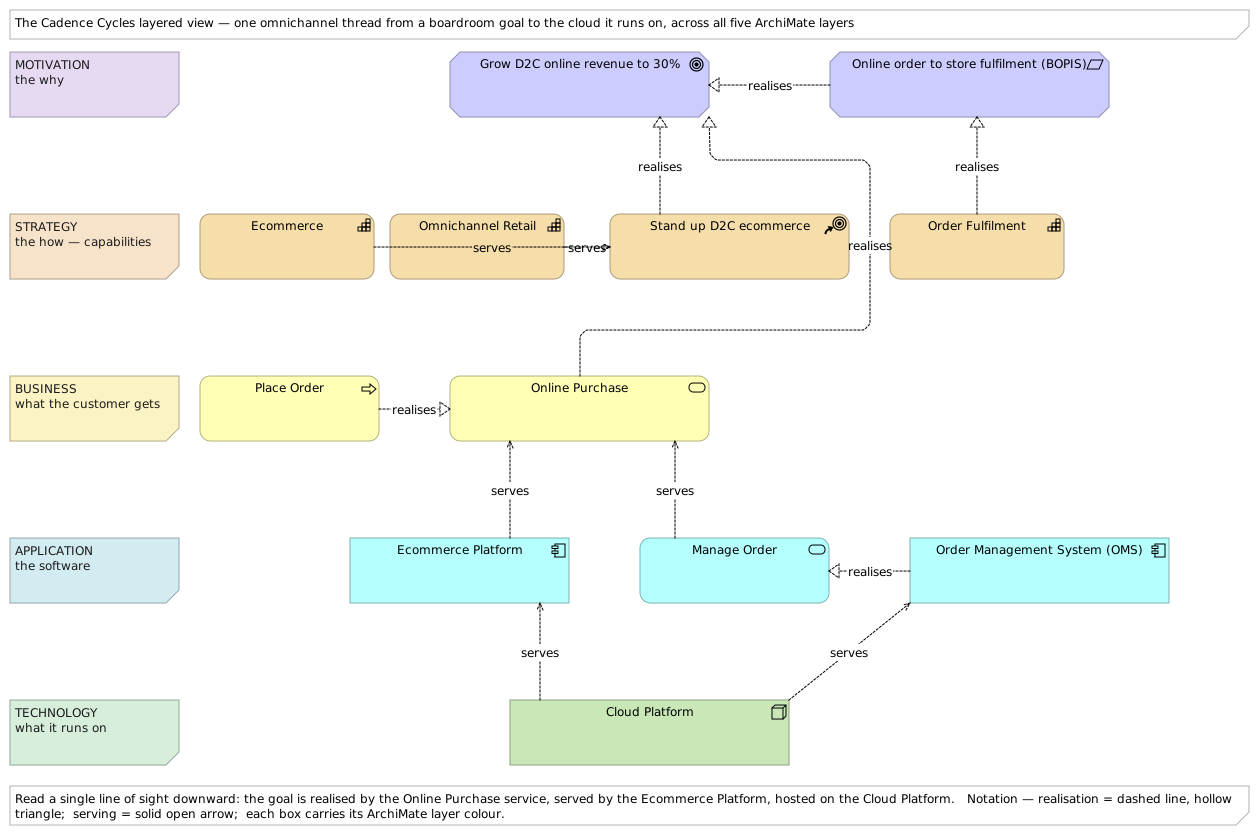
The Cadence Cycles layered view — an authentic Archi export, and the centrepiece of this section. Each horizontal band is an ArchiMate layer, carrying its signature colour: Motivation (purple), Strategy (tan), Business (yellow), Application (cyan), Technology (green). A dashed line with a hollow triangle is realisation (the lower thing makes the higher thing real); a solid open arrow marked "serves" is a serving relationship. Read one vertical line of sight to see a promise become a machine.
Trace the spine downward, and read the model as one sentence:
- Motivation. The goal Grow D2C online revenue to 30% is what all of this is for. The requirement Online order → store fulfilment (BOPIS) realises that goal — a concrete thing a solution must do.
- Strategy. The course of action Stand up D2C ecommerce realises the goal, and the capabilities Ecommerce and Omnichannel Retail serve that initiative; Order Fulfilment realises the BOPIS requirement. This is the how, at portfolio altitude — the very capabilities the heat map flagged hot.
- Business. The business service Online Purchase realises the goal directly, and the Place Order process realises the service. This is what the customer actually experiences.
- Application. The Ecommerce Platform component serves Online Purchase; so does the application service Manage Order, which the Order Management System (OMS) realises. This is the software that makes the service run.
- Technology. The Cloud Platform node serves both the Ecommerce Platform and the OMS. This is the machine it all lands on.
The result is an unbroken line of sight — goal → service → component → node — that you can walk in either direction. Top-down, it answers "how are we delivering this goal, concretely, all the way to the metal?" Bottom-up, it answers the question every change review asks: "if the Cloud Platform has an outage, what customer promise and which strategic goal are at risk?" — and the diagram traces it straight back up to Grow D2C online revenue to 30%.
So what — which decision this drives
The layered view is what makes an enterprise-architecture practice worth the ceremony. Because it is a view onto the one shared model — not a hand-drawn picture — the traceability is real: change a component and you can read off the services, capabilities, and goals it touches; question a goal and you can read off the systems and infrastructure spend it justifies. That two-way traceability is the input to impact analysis, portfolio prioritisation, and the business case for every line item in the roadmap. It is also the honest test of the whole model: if a goal doesn't trace to a system, or a system doesn't trace to a goal, the layered view is where the gap becomes impossible to ignore.
A curated slice, not the whole model
The layered view deliberately shows one thread, not every element — a readable diagram beats a complete one. The discipline is to pick the slice that tells the decision's story (here, the D2C-revenue thread) and let the reader trust that the same model holds the rest. A layered view that tries to show everything becomes the "wiring diagram nobody reads"; a curated one becomes the slide that gets the roadmap funded.
Where to go next
- Capability heat-maps — the scoring behind the hot capabilities that anchor this cross-map and layered view.
- Business — the two value streams drawn separately, and the process view beneath the online stream.
- Strategy — the capability map and the courses of action the layered view's strategy band draws on.
- Motivation — the goal and requirement at the top of the layered view, and the assessments that justify them.