Business layer
The Strategy layer says what the enterprise is able to do, at portfolio altitude. The Business layer is where those capabilities become concrete: the people who do the work, the roles they act in, the processes they follow, and — the reason any of it exists — the services and products a customer actually receives. This is the layer business stakeholders recognise as "the business," and it is where two of the most useful artefacts in the whole practice live: the business cooperation view and the value stream.
This page introduces the Business vocabulary one distinction at a time — the ones people routinely get wrong (actor vs role, service vs process vs function, product) — then builds the Cadence Cycles cooperation view, the two value streams the transformation is really about, and one process end to end.
What the Business layer captures
- Active structure — business actors (who) and the business roles they are assigned to (in what capacity).
- Behaviour — business processes, functions, and interactions (how the work happens) that realise…
- Services — business services, the externally-visible behaviour the enterprise offers, described from the consumer's side.
- Passive & offering — business objects (what the work is about) and products (a coherent bundle of services and a contract, sold as one thing).
In the TOGAF ADM this is the heart of Phase B (Business Architecture) — where the strategic capabilities of Phase A are realised as concrete services, processes, and organisation.
Actor vs role — the distinction to get right
A business actor is a who: a person, team, or organisational unit — an entity that actually exists on the org chart. A business role is the capacity in which an actor acts — the named responsibility that behaviour is attached to. An actor is assigned to a role; the role, not the actor, performs the work and is served by the services.
The reason to separate them is the same reason capabilities beat org boxes: it keeps the model stable while people and org design churn. At Cadence a single Store Associate plays two roles — Sales Advisor on the shop floor and Cashier at the till — and a Customer Service Rep plays both Returns Handler and Support Agent. Model the roles, attach the processes to the roles, and the picture survives the day the store reshuffles who does what. The customer, too, is modelled as an actor (Online Shopper) playing a role (Buyer) — because it is the Buyer capacity, not the person, that the services serve.
Service vs process vs function
These three are the most-confused words in the layer, so pin them down:
- A business process is how and in what order work happens — a sequence of steps with a beginning and an end, triggered by an event, producing a result. "Pick & Pack." "Ring Up Sale." Processes are about flow and sequence.
- A business function groups behaviour by the skills or resources it needs, independent of sequence — "Fulfilment," "Payments" as ongoing competencies. (Cadence's competencies are already captured one layer up as capabilities, so this page leans on processes; functions are the same idea seen by resource rather than by flow.)
- A business service is the externally-visible behaviour the enterprise exposes, named from the consumer's point of view — "Online Purchase," "Warranty," "Click-and-Collect." A service hides the process behind it: the customer cares that they can return a bike, not which steps the Returns Handler follows.
The wiring between them is precise and always the same shape: a role performs a process (assignment), and a process realises a service (realization), which in turn serves an actor or role (serving). Get that little grammar right and the rest of the layer falls out of it.
Product — the thing you actually sell
A product bundles one or more services (and, formally, a contract) into a single coherent offering a customer can buy. It is the commercial packaging over the services. Cadence sells three: a Bicycle (bought in-store or online, and covered by Warranty), Accessories, and the premium Assembled-and-tuned bike (the value-added offer that leans on Click-and-Collect and Warranty — exactly the omnichannel strength the Motivation assessment called out). A product aggregates its services: it is a view of the same behaviour, packaged to sell.
The Cadence Cycles business cooperation view
A cooperation view answers who is involved and what is on offer. The top block is the offering: the Buyer (played by the Online Shopper), served by the five business services, which the three products aggregate. The bottom block is the workforce: each actor and the role(s) it is assigned to — the actor-vs-role structure made visible.
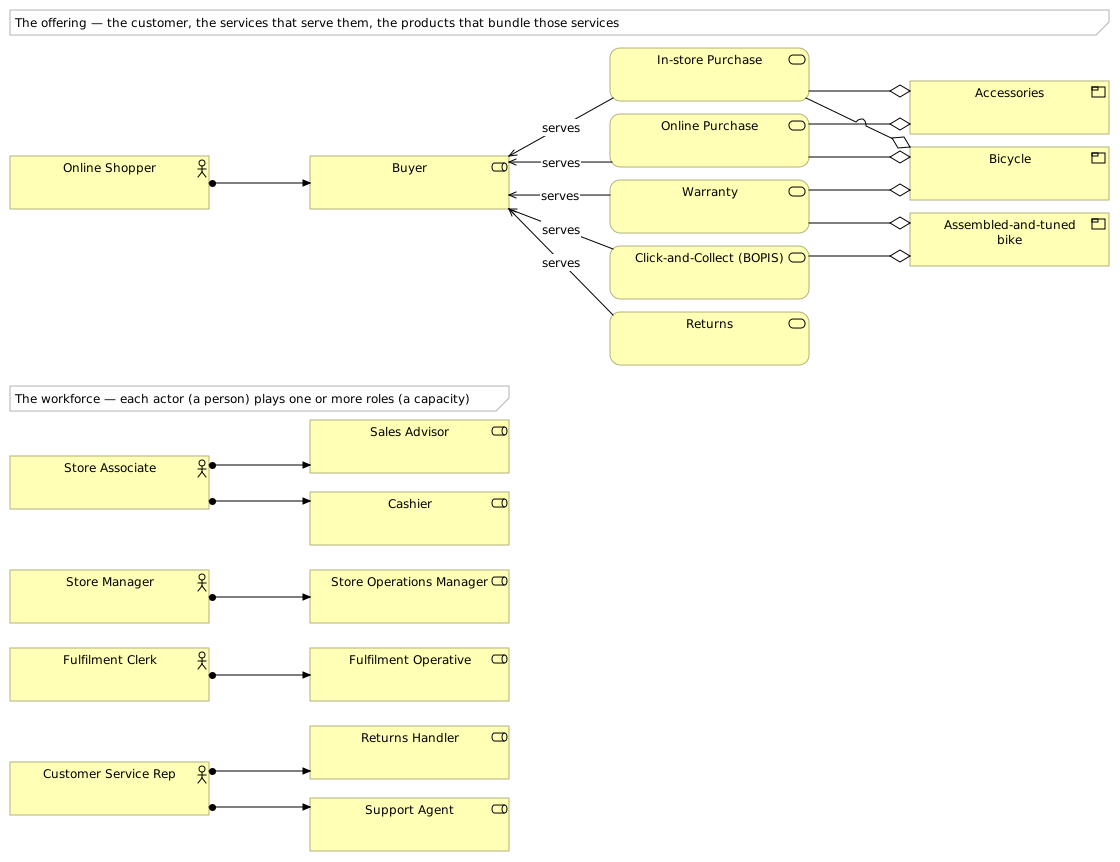
The Cadence Cycles business cooperation view — an authentic Archi export. Yellow is the Business layer. A line with a filled ball is assignment (an actor plays a role); the solid arrow marked serves is a serving relationship (a service serves the Buyer); the open-diamond line is aggregation (a product bundles services). The workforce (bottom) connects to the services it delivers through the processes below — the subject of the process view.
Read it as two honest halves. The top says what a customer can get and how it is packaged; the bottom says who the business is. Deliberately, the staff roles do not touch the services directly here — in ArchiMate a role only reaches a service through the process it performs, and that behaviour is the next view's job. A cooperation view is about structure, not flow.
Value streams — the outcome the customer is really after
A value stream is an end-to-end sequence of stages that, together, deliver a result of value to a stakeholder — told from their side, not the org's. It is the single most useful lens for an omnichannel programme because it crosses every silo: one online order touches marketing, ecommerce, the warehouse, and the store, and the value stream is the only artefact that shows that journey as one thing.
Value stream vs business process — not the same thing
They look alike; they answer different questions.
- A value stream is outcome-first and customer-facing: what value accrues at each stage, named so a customer or executive nods along (Browse → Order → Pay → Pick → Ship / Collect). It is stable and channel-spanning, and it lives at strategy altitude — a Value Stream is a Strategy-layer element, like a capability.
- A business process is operations-first and internal: the concrete, triggered steps a role executes to make a stage happen. It is where the work — and the automation, and the cost — actually is.
One stage is realised by one or more processes; each stage is served by the capability that makes it possible. That last link — value-stream stage ↔ capability — is what lets you point at a stumbling stage and know exactly which ability to invest in.
Cadence runs two value streams, one per channel — and side by side they are the omnichannel story.
Sell a bike in-store
The walk-in journey: from being greeted to riding away on a tuned bike. Its four stages lean almost entirely on one capability — In-store Sales — with Order Fulfilment finishing the job at handover. This is the stream Cadence is already strong at; the assessment "stores strong on fitting/service" is this diagram.
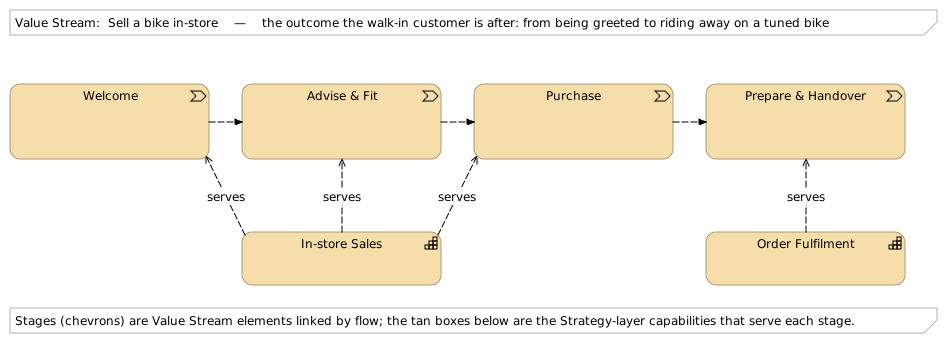
"Sell a bike in-store," an authentic Archi export. Each chevron is a Value Stream stage; the arrows between them are flow; the tan boxes are the Strategy-layer capabilities that serve each stage.
Fulfil an online order
The online journey — Browse → Order → Pay → Pick → Ship / Collect — is the one the transformation is investing in, and its stages fan across four different capabilities: Marketing gets the customer to Browse, Ecommerce owns Order and Pay, Order Fulfilment does the Pick, and Omnichannel Retail closes it out at Ship / Collect (the stage where a shipped parcel and an in-store BOPIS pickup are the same value stream ending two ways).
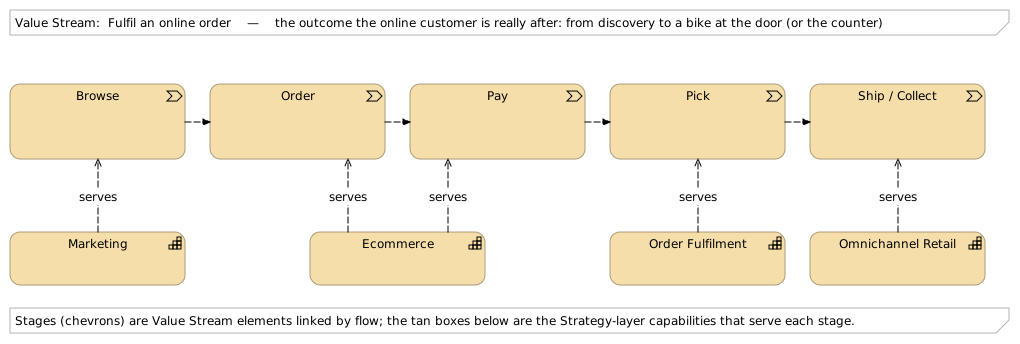
"Fulfil an online order," an authentic Archi export. Same notation: chevron stages linked by flow, each served by the capability below it. Note how many more capabilities this stream spans than the in-store one — a visual statement of why omnichannel is hard.
Why draw both value streams the same way
Laying the two streams out identically — same chevrons, same "capability below the stage" convention — turns them into a comparison. The in-store stream rests on one strong capability; the online stream is spread thin across four, two of which (Ecommerce, Omnichannel Retail) are exactly the ones the Strategy heat map will flag as important but immature. The value stream is where a capability gap stops being abstract.
One process, end to end: Fulfil an online order
Drop from the value stream's altitude to the operational floor and the Fulfil an online order stream becomes a business process — the same journey, now as concrete, triggered steps with a role on each and the service each one realises.
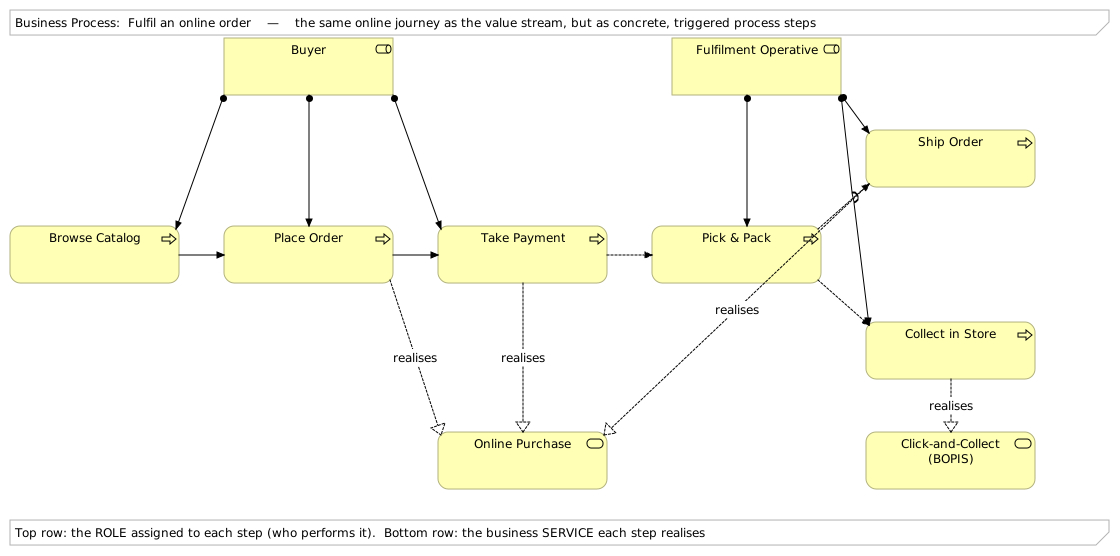
The "Fulfil an online order" business process — an authentic Archi export. The solid arrows between steps are triggering (the flow of control); the filled-ball lines from the top are assignment (the role that performs each step); the dashed hollow-triangle arrows to the bottom are realization (the service each step makes real). The Buyer self-serves Browse → Order → Pay; the Fulfilment Operative takes over at Pick & Pack, which then branches to either Ship Order or Collect in Store — the two ways an online order ends.
That branch is the whole omnichannel point in one picture: a single online process that can terminate as a home delivery or a store pickup, realising either the Online Purchase or the Click-and-Collect (BOPIS) service off the same pick. Modelling it once, at the business layer, is what stops "BOPIS" from becoming a bolt-on nobody's architecture actually accounts for.
So what — which decision this drives
The Business layer is where strategy stops being a slide. Once the value streams and this process are modelled, three questions get sharp answers: which capability do we fix to unblock the online stream? (the stage-to- capability serving links point straight at Ecommerce and Omnichannel Retail); what has to be true for BOPIS to work? (the Collect in Store step and its service must be real, not implied); and who owns each step? (the role assignments). The next layer down — Application — answers each process step with the systems that support it, and the traceability you built here is what keeps that honest.
Where to go next
- Application layer (coming next) — answer each business process step with the components and application services (POS, Ecommerce Platform, OMS, Inventory) that support it.
- Strategy — the capabilities these value-stream stages are served by, and the capability map they belong to.
- Motivation — the goals, requirements, and the "stores are an asset" assessment that these services and value streams exist to satisfy.