Capability heat-maps
The Strategy page built the capability map — the complete, stable inventory of what the enterprise can do, grouped into areas. On its own that map is an excellent filing cabinet and a poor decision tool: it says what exists, not where to act. A heat map is the capability map with a score baked into every tile's colour, and that one addition turns "where should we invest?" from a slide-deck argument into an analysis you can defend.
This page pins down what a heat map is, the importance × maturity-gap scoring behind it, how to read the Cadence Cycles heat map, and how the colours drive an investment roadmap.
What a capability heat map adds
- The same tiles — a heat map never invents new capabilities; it colours the ones already on the map, so the analysis stays anchored to a stable, agreed structure.
- A score per capability — a small, explicit rubric (here, strategic importance against the maturity gap) reduced to a single band.
- A colour scale — hot to cool, so a room full of people can read the priorities in seconds and argue about the scores, not the picture.
In the TOGAF ADM this is the analytical heart of Phase A and the input to the Architecture Roadmap: capability-based planning is precisely the act of scoring capabilities and sequencing the investment that follows.
What a heat map is — and is not
A capability heat map assigns each capability a colour that encodes a judgement about that capability, so the whole portfolio can be compared at a glance. The judgement is the point. A heat map is not a status report and not a RAG dashboard of running projects — it is a strategic assessment of the enterprise's abilities against a specific ambition. Change the ambition and the colours change; the tiles do not.
That distinction is what keeps a heat map honest. Because the tiles are the same stable capabilities every other diagram uses, a heat map cannot quietly redefine the business to make the numbers look good — it can only re-score a fixed set of things. And because the score is explicit, a stakeholder who disagrees has to say which capability they'd re-band and why, which is a far more productive argument than "I don't like the roadmap."
The score: strategic importance × maturity gap
Cadence scores each capability on two axes, both read against the omnichannel strategy — not in the abstract:
- Strategic importance — how much this ability matters to winning at omnichannel. Ecommerce is existential; HR is essential to run a company but is not where an omnichannel programme is won or lost. Importance is strategy-relative: the same capability scores differently under a different ambition.
- Maturity gap — the distance between the maturity the strategy needs and the maturity Cadence has today. A capability the company is superb at scores a small gap even if it matters enormously; a capability that is both important and weak scores a wide one.
The investment priority is the product of the two:
score = strategic importance × maturity gap
A capability only runs hot when it is both important and short of where it needs to be. That multiplication is deliberate: it stops two failure modes at once — pouring money into an ability the company is already great at (high importance, no gap), and polishing an ability nobody's strategy depends on (wide gap, low importance). Only the top-right quadrant — important and immature — earns the hottest colour.
Where the scores come from — trace them to the Motivation layer
Good heat-map scores are not opinions; they are read straight off the Motivation assessments. Cadence's assessment "stores strong on fitting/service, weak online" is exactly why In-store Sales scores a small gap (cool) while Ecommerce scores a wide one (hot). The assessment "no single view of inventory" is why Inventory Management runs hot. When an auditor asks "why is this one red?", the answer is a modelled assessment, not a hunch — the traceability you built two layers up is what makes the heat map defensible.
The Cadence Cycles capability heat map
Colour the twelve tiles by that score and the omnichannel programme's shape jumps off the page.
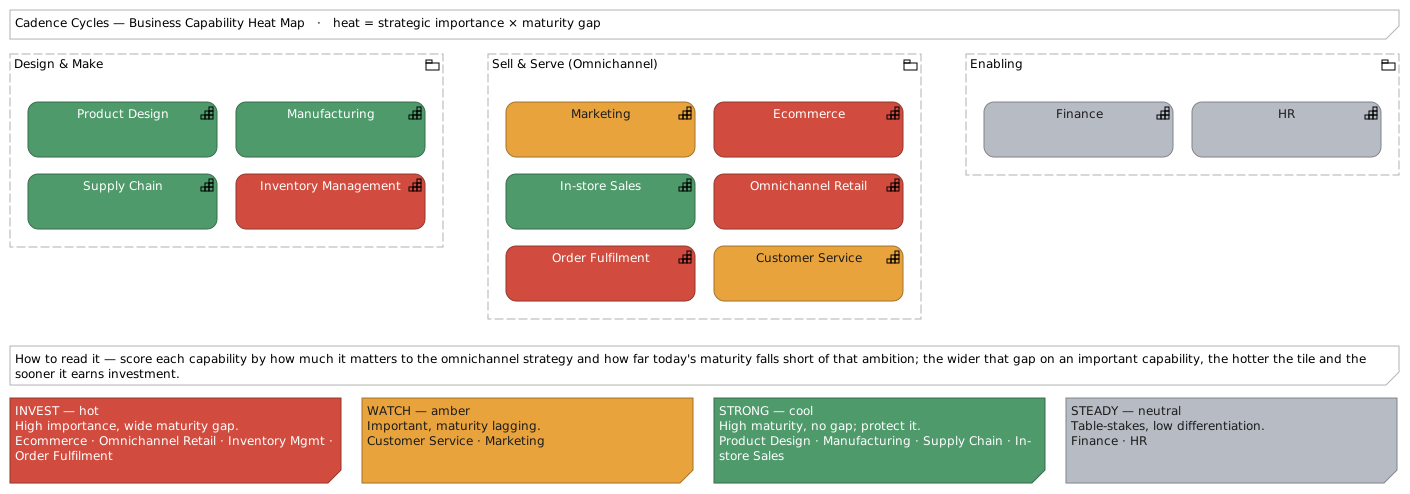
The Cadence Cycles capability heat map — an authentic Archi export of the same capability map, each Capability tile filled by its investment-priority band. The dashed containers are the same Grouping areas; only the tiles' colours carry new information. The legend beneath the map defines the four bands.
Read it band by band:
- Invest — hot (red). Ecommerce, Omnichannel Retail, Inventory Management, and Order Fulfilment. Every one is central to the omnichannel goal and materially short of where it needs to be: the storefront is new, BOPIS doesn't exist yet, there is no single view of stock, and fulfilment now has to serve an online channel it was never built for. These four are the programme.
- Watch — amber. Customer Service and Marketing. Important to the online experience and lagging, but not the critical path — fund them after the hot four, and watch that they don't slip from amber to red as online volume grows.
- Strong — cool (green). Product Design, Manufacturing, Supply Chain, and In-store Sales. Cadence's heritage strengths as a maker of good bikes sold well in stores. The strategy leans on these; it does not need to fix them. The correct action on a green tile is protect, not invest.
- Steady — neutral (grey). Finance and HR. Table-stakes enabling abilities every company needs and few win on. Keep them healthy; expect no omnichannel edge from them.
The single most useful thing the picture says is negative: three-quarters of the capabilities are not where the money goes. The heat map's job is as much to grant permission to leave Manufacturing alone as it is to flag Ecommerce — and saying "no" to the strong-but-safe capabilities is usually the harder, more valuable half of the conversation.
So what — which decision this drives
A heat map converts a portfolio of abilities into a ranked investment thesis. Cadence's map reads out in one sentence: concentrate the transformation spend where the tiles run hot — Ecommerce, Omnichannel Retail, Inventory Management, and Order Fulfilment; keep pace on the amber capabilities, Customer Service and Marketing; protect the Design & Make strengths; and expect nothing strategic from Finance or HR. That is a defensible answer to "where do we invest?" — traceable down to modelled assessments and up to the goals — produced before anyone writes a line of code or picks a vendor.
From heat map to roadmap
A heat map ranks; it does not yet sequence. The step from colour to plan is to take the hot capabilities and ask, in order, what has to be true for each to reach its target maturity — which is where the heat map hands off to the rest of the model:
- Hot capability → course of action. Each red tile already maps to a Strategy-layer course of action — Ecommerce and Omnichannel Retail to Stand up D2C ecommerce, Inventory Management to Unify inventory across channels, Order Fulfilment to Enable BOPIS. The heat map says which abilities; the courses of action say how they get built.
- Course of action → value stream and systems. Each initiative lands on the value streams it improves and the application and technology components that must change — the traceable chain the next page draws end to end.
- Sequence by dependency and risk. Inventory Management underpins both BOPIS and a truthful storefront, so it is sequenced early; Omnichannel Retail depends on it, so it follows. The heat map ranks by priority; the roadmap re-orders by dependency.
The result is a roadmap whose every step traces back to a red tile, and every red tile back to a modelled assessment — a plan you can walk backwards from any delivery date to the strategic reason it exists.
Where to go next
- Value streams — the end-to-end streams, the value-stream ↔ capability cross-map, and the hero layered view that ties all five layers into one picture.
- Strategy — the plain capability map these tiles come from, and the courses of action each hot capability maps to.
- Motivation — the assessments and goals that supply the importance and maturity scores behind every colour.