Enterprise Architecture
This section is a working introduction to enterprise architecture (EA) as it is actually practised: modelling with ArchiMate inside a TOGAF method. It is not a notation cheat-sheet. Every concept is shown applied to one running example — Cadence Cycles — so you can see not just what a diagram means but which decision it drives and who it is for.
What you'll get out of this section
- A precise mental model of the ArchiMate layers and how they stack.
- How the TOGAF Architecture Development Method (ADM) turns those models into a governed change programme.
- Enough worked, opinionated examples to slot into an enterprise EA practice — or to start one.
Every diagram here is a real Archi export regenerated from committed source (see How the diagrams are made), never hand-drawn.
ArchiMate and TOGAF: two things, one practice
People reach for "enterprise architecture" to answer a hard question: given where the business wants to go, what has to change across our people, processes, applications, and infrastructure — and in what order? Two open standards from The Open Group carry most of that load, and they do different jobs:
| TOGAF | ArchiMate | |
|---|---|---|
| What it is | A method and framework — how to run an architecture practice | A modelling language — how to describe an architecture |
| Answers | What do I do, in what order, to produce and govern an architecture? | How do I draw the business, apps, and technology so everyone reads them the same way? |
| Core artefact | The ADM cycle (Preliminary, Phases A–H) + the Architecture Repository | A layered set of elements and relationships with a standard notation |
| Analogy | The process — the recipe and the kitchen rules | The vocabulary — a shared language for the dish |
They are complementary. TOGAF tells you when you need a Business Architecture or a Technology Architecture; ArchiMate gives you a rigorous, tool-checkable way to actually express one. This section teaches them together: ArchiMate views as the deliverables that flow through the TOGAF ADM.
Versions
Examples target ArchiMate 3.2 and TOGAF 10 (the TOGAF Standard, 10th Edition). Both are stable; almost everything here applies unchanged to TOGAF 9.2 and ArchiMate 3.1.
The layered framework
ArchiMate organises the enterprise into layers, each a different altitude of concern. Reading top to bottom is reading why → what → how:
- Motivation — the why: stakeholders, drivers, assessments, goals, outcomes, principles, requirements, constraints. Not "the architecture" itself but the reasons behind it.
- Strategy — the what, at portfolio altitude: the capabilities the enterprise has or needs, the resources behind them, and the courses of action it will pursue.
- Business — the what, operationally: actors and roles, business processes and functions, the services and products offered to customers, and the value streams that deliver them.
- Application — the how, in software: application components and the services they expose, the data objects they own.
- Technology — the how, in infrastructure: nodes, devices, system software, networks, and the artifacts deployed onto them.
- Physical and Implementation & Migration round out the picture — the physical world (equipment, facilities, materials) and the change programme itself (work packages, deliverables, plateaus, gaps).
The power is in the relationships between layers: a capability is realised by a business service, which is served by an application service, which is served by a technology node. Trace those links and you can answer questions no single layer can — "if we retire this server, which customer-facing services break, and which strategic goal slips?"
The notation, at a glance
Each layer has a colour and each element type an icon. Learn to read those two cues and any ArchiMate diagram becomes legible. Here is one element of each key type, grouped by layer:
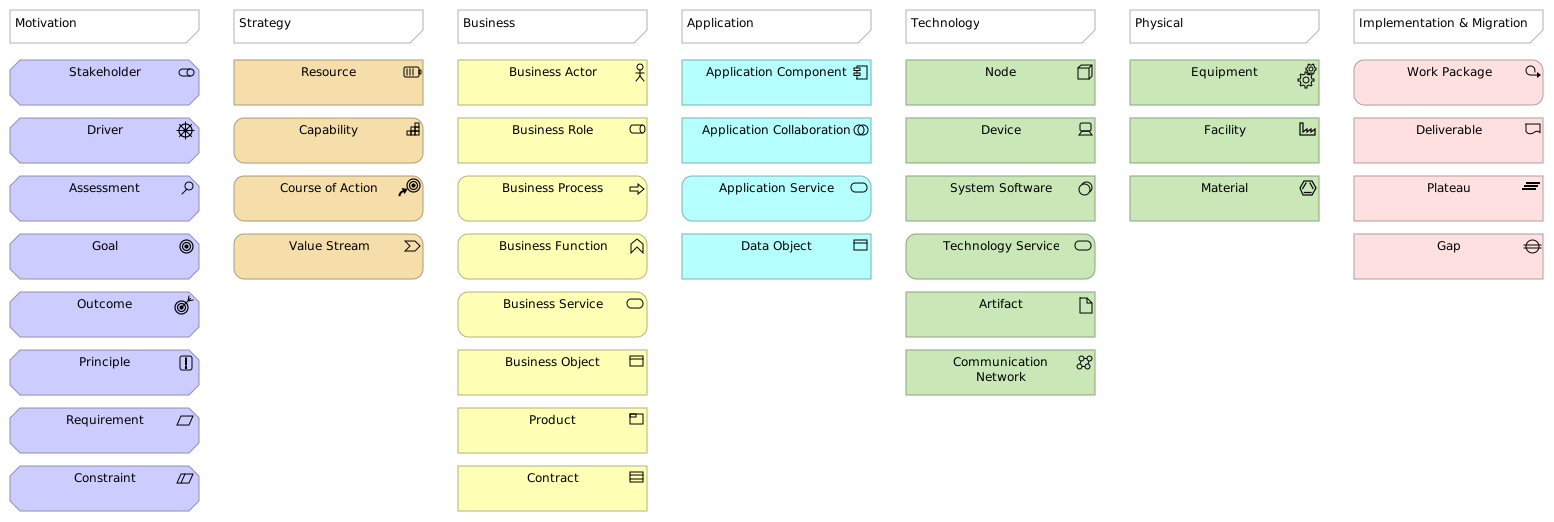
The Cadence Cycles notation legend — an authentic Archi export. Fill colour encodes the layer; the small glyph top-right encodes the element type.
| Layer | Default colour | Typical elements |
|---|---|---|
| Motivation | purple #ccccff |
Stakeholder, Driver, Assessment, Goal, Outcome, Principle, Requirement, Constraint |
| Strategy | tan #f5deaa |
Resource, Capability, Course of Action, Value Stream |
| Business | yellow #ffffb5 |
Business Actor, Role, Process, Function, Service, Object, Product, Contract |
| Application | cyan #b5ffff |
Application Component, Collaboration, Service, Data Object |
| Technology | green #c9e7b7 |
Node, Device, System Software, Technology Service, Artifact, Communication Network |
| Physical | green #c9e7b7 |
Equipment, Facility, Material |
| Implementation & Migration | pink #ffe0e0 |
Work Package, Deliverable, Plateau, Gap |
Colour is a convention, not a rule
These are Archi's default fills and the de-facto standard. ArchiMate itself only recommends the palette; some shops recolour to a house style. Read the icon first — it is normative — and treat colour as a fast secondary cue. (Technology and Physical share the same green by default; the icons tell them apart.)
How the layers connect
The single most important habit in ArchiMate is reading across layers. Here is the smallest possible cross-layer slice from the Cadence Cycles model — one real element per layer, stacked, with the dependency chain that ties a piece of infrastructure all the way up to a strategic goal:
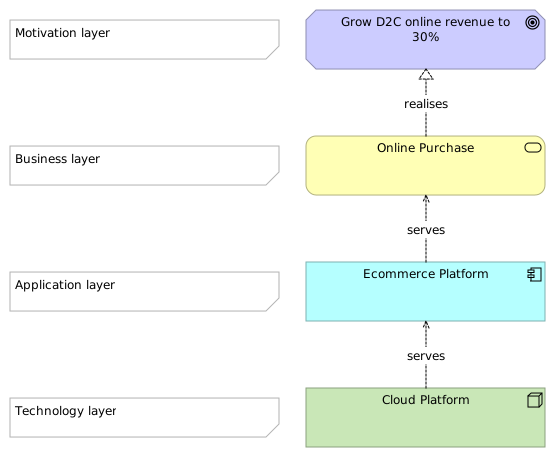
One goal, realised through the stack. Read bottom-up: the Cloud Platform serves the Ecommerce Platform, which serves the Online Purchase business service, which realises the goal Grow D2C online revenue to 30%. The dashed hollow-triangle arrow is realisation; the solid open arrow is serving.
That one thread is the seed of everything the rest of this section builds: motivation at the top, technology at the bottom, and traceable relationships in between.
The running example: Cadence Cycles
Throughout this section we model Cadence Cycles, a mid-size bicycle manufacturer. Cadence sells through two channels: its own retail stores (where staff fit, assemble, and tune bikes) and a newer direct-to-consumer ecommerce site. The company is mid-way through an "omnichannel" transformation — it wants the two channels to feel like one business, with a single view of inventory and the customer.
That gives us every layer to model and real tensions to reason about:
- Motivation — declining store foot-traffic and online-native competitors are pushing a goal to grow D2C online revenue to 30% and unify inventory.
- Strategy — new capabilities (Ecommerce, Omnichannel Retail, Order Fulfilment) sit alongside the ones that always paid the bills (Manufacturing, In-store Sales).
- Business → Application → Technology — value streams like "Fulfil an online order" run across a POS system, an ecommerce platform, an order management system, and the cloud and in-store infrastructure beneath them.
We grow one Cadence Cycles model milestone by milestone as the section expands, so later diagrams are consistent slices of the same enterprise rather than disconnected examples.
Why an EA shop uses this
- A shared language. ArchiMate gives business, application, and infrastructure people one notation, so a "service" or a "capability" means the same thing in every room.
- Traceability. Because relationships cross layers, you can answer impact-and-dependency questions directly from the model — up (which goal does this serve?) and down (what breaks if this changes?).
- A repeatable method. TOGAF's ADM makes architecture a governed cycle, not a one-off slide deck: vision, business, information-systems, and technology architectures, then planning, governance, and change management.
- Better decisions, cheaper. Capability heat maps and gap analysis turn "where should we invest?" into a defensible, evidence-backed answer before anyone writes code.
How the diagrams are made
Every ArchiMate view in this section is generated by the real Archi tool, headless, from committed source — so the diagrams are authentic, consistent, and reproducible:
- The whole enterprise lives in one model,
archi/cadence-cycles.archimate, built and grown by scriptable jArchi views (archi/views/*.ajs). - A small
archi-rendercontainer image bakes Archi + a source-built jArchi - the headless rendering stack.
make diagramsruns it to regenerate every SVG underimg/deterministically. - The
.ajsscripts and the.archimatemodel are the diff-able source; the SVGs are build outputs committed for the static site.
The upshot: no hand-drawn boxes drifting out of date. Change the model, run
make diagrams, and the pictures follow.
Where to go next
- TOGAF & the ADM — the method: the ADM cycle, what each phase produces, and how ArchiMate deliverables map onto it.
- Motivation — stakeholders, drivers, assessments, goals, outcomes, principles, and the requirements that become the contract for everything downstream.
- Strategy — capabilities, resources, courses of action, and the section's marquee capability map.
- Business, Application, Technology (coming next) — the core layers, the two Cadence value streams, and the usage views that connect them.
This section is growing
Overview, TOGAF/ADM, and the Motivation and Strategy layers (including the capability map) are complete; the remaining per-layer pages, the capability heat-maps, the end-to-end value streams, and a full worked example ("launch the ecommerce channel", top to bottom) are being filled out milestone by milestone.