Strategy layer
The Motivation layer says why. The Strategy layer is the first answer to what — but at portfolio altitude, above any particular process or system. It has just three element types — capabilities, resources, and courses of action — and one breakout idea that is arguably the most useful artefact in all of enterprise architecture: the capability map. This page introduces that idea properly, then builds the Cadence Cycles strategy view and the full capability map.
What the Strategy layer captures
- Capabilities — what the enterprise is able to do, independent of how or who does it.
- Resources — the assets (tangible and intangible) that back those capabilities.
- Courses of action — the planned initiatives that configure capabilities and resources to reach the goals.
In the TOGAF ADM this is the language of Phase A (the strategic, capability-based view of the target) and the bridge into Phase B, where capabilities are realised by business services.
Capability: the one idea to get right
A capability is an ability that the enterprise possesses — expressed as an outcome, not an activity. "Order Fulfilment." "Inventory Management." "Ecommerce." Note what a capability is not:
- It is not an org chart box. "Order Fulfilment" is a capability whether one team, three teams, or an outsourcer performs it. Capabilities are stable even as reporting lines churn.
- It is not a process. A process is how and in what order work happens; a capability is what you can do. One capability is usually realised by several processes, applications, and people — you'll see exactly that when the Business and Application layers wire it up.
- It is not a system. "Payments" the capability outlives whichever gateway currently implements it.
That stability is the point. Because a capability doesn't move when the organisation reorganises or re-platforms, it is the perfect unit of planning: you can talk about "how important is Ecommerce, and how good are we at it?" without the conversation collapsing into which team or tool owns it. That is what makes capability-based planning — and the heat-mapped capability map later in this section — possible.
Resources and courses of action
A resource is an asset the enterprise owns or controls and puts behind its capabilities — a plant, a store estate, a brand, data, skills, cash. Resources are assigned to capabilities: they are the raw material that makes an ability real. Cadence brings three to the table — a retail store network, a manufacturing plant, and a brand — and part of the omnichannel thesis is that the store network, often seen as a cost in an online war, is actually a fulfilment and service asset other D2C brands can't match.
A course of action is an approach or plan — the way the enterprise will configure its capabilities and resources to reach a goal. Courses of action are where strategy becomes a programme. Cadence has three, and each maps to a goal from the Motivation layer: stand up D2C ecommerce, unify inventory across channels, and enable BOPIS (buy online, pick up in store).
The Cadence Cycles strategy view
This view reads left to right as the strategy sentence: resources are assigned to capabilities; capabilities serve the courses of action that rely on them; and each course of action realises a goal.
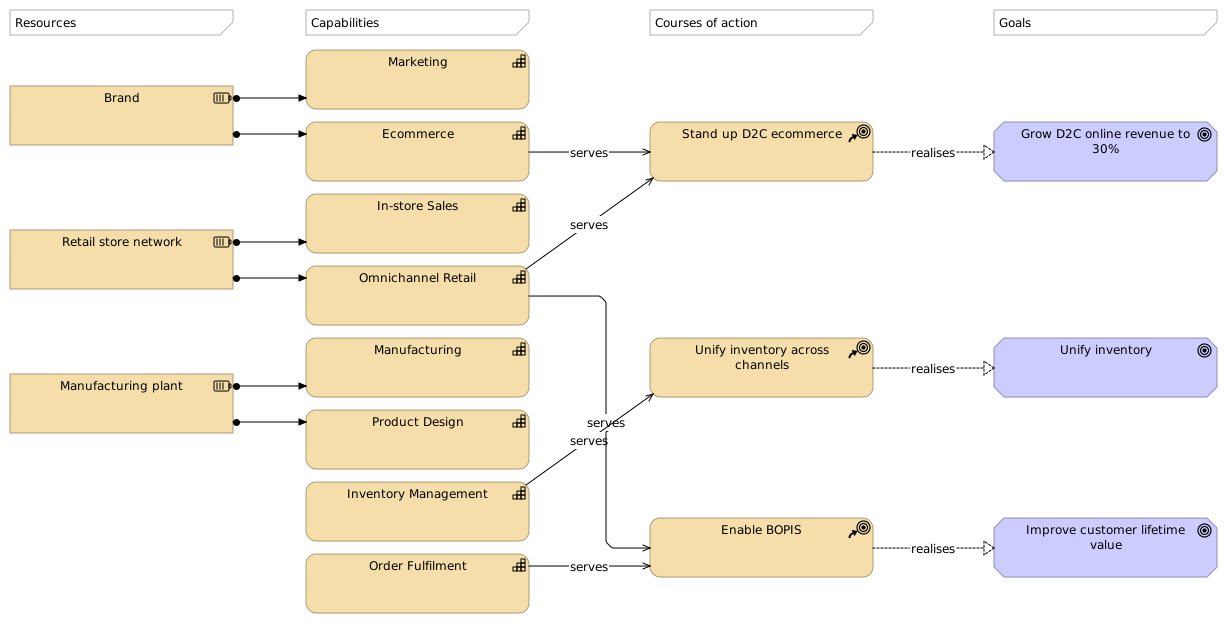
The Cadence Cycles Strategy view — an authentic Archi export. Tan is the Strategy layer; purple (right) are the Motivation goals it reaches. A line with a filled ball is assignment (a resource provides a capability); the solid arrow marked serves is a serving relationship (a capability enables a course of action); the dashed hollow-triangle arrow marked realises is realisation (a course of action makes a goal true).
Trace one thread: the brand and ecommerce capability, together with omnichannel retail, serve stand up D2C ecommerce, which realises grow D2C online revenue to 30%. That single line of sight — asset → ability → initiative → goal — is what a strategy layer buys you, and it connects straight up into the requirements you saw on the Motivation page (a capability also realises those requirements; here we show the initiative-to-goal end of the same chain).
The capability map
Line every capability up, group it, and you get the capability map — the single most reused diagram an EA practice produces. It is deliberately boring and stable: no processes, no systems, no arrows — just the complete set of things the enterprise can do, organised into areas. That stability is its superpower. The same map is the backdrop for investment decisions, org design, application rationalisation, M&A due diligence, and the roadmap.
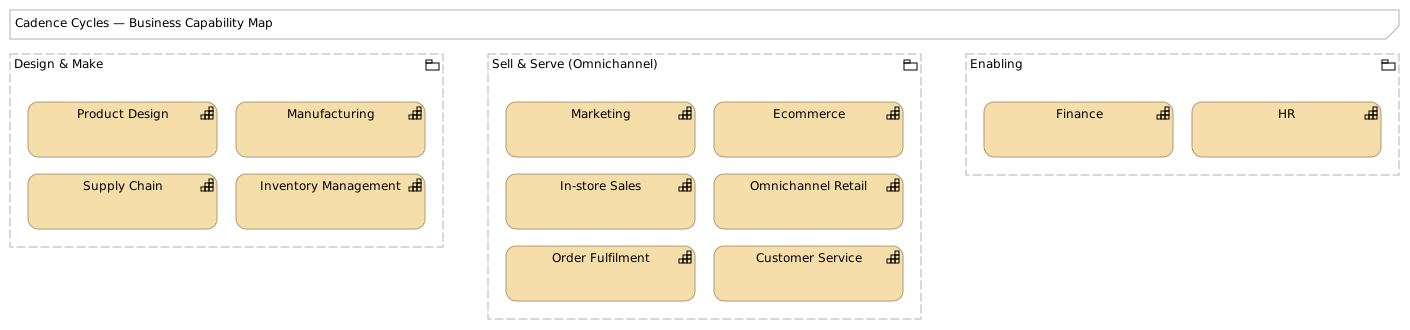
The Cadence Cycles business capability map — an authentic Archi export. Each tan tile is an ArchiMate Capability; the dashed containers are Grouping elements that partition the map into areas. Membership is shown by nesting, the capability-map convention. Twelve capabilities across three tiers: Design & Make (the upstream product and supply abilities), Sell & Serve (Omnichannel) (the customer-facing abilities where the transformation lives), and Enabling (the corporate support abilities every business needs).
A good map is complete, non-overlapping, and outcome-named. Cadence's fits on one screen and still says something: the omnichannel programme is almost entirely a Sell & Serve story — Ecommerce, Omnichannel Retail, Order Fulfilment, and (spanning make and sell) Inventory Management are the abilities under pressure — while Design & Make and Enabling stay comparatively steady. That observation is a hypothesis you can now test rather than assert.
Grouping is a container, not a layer
The three areas are ArchiMate Grouping elements (dashed border, folder glyph). Grouping has no domain meaning of its own — it just says "these belong together" — which is exactly what a capability-map area needs. Some shops use nested capabilities instead (Level-1 → Level-2 decomposition); either reads the same way. Keep the areas stable: if they churn every planning cycle, they aren't capabilities.
So what — which decision this drives
The capability map turns "where should we invest?" from a debate into an analysis. On its own it's an inventory; its power shows up when you score each tile — by strategic importance, by current maturity, and by target — and colour the map accordingly. That heat map (built in a later milestone from these very tiles) is what tells Cadence to pour money into Ecommerce and Inventory Management and to leave Manufacturing alone — a defensible, evidence-backed answer before anyone writes a line of code.
Where to go next
- Business — realise these capabilities as concrete actors, roles, services, and the two Cadence value streams.
- Capability heat-maps — score and colour the map above by importance and maturity gap to drive the investment roadmap.
- Motivation — the goals and requirements these capabilities and courses of action exist to satisfy.